


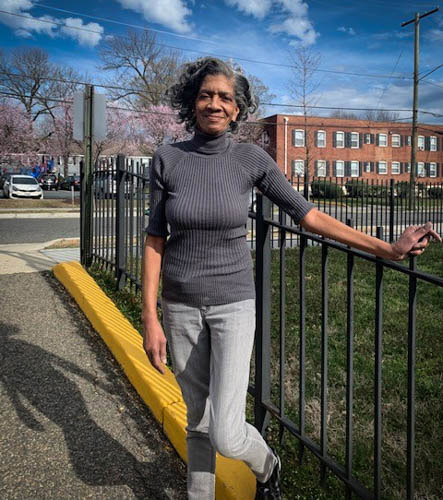
 When Evelyn Harrison learned her apartment building in Southeast Washington, D.C., was being sold she was shocked. "We were surprised because we never heard anything about it," says Evelyn. Staff from a local nonprofit, Latino Economic Development Center (LEDC), handed out flyers to warn residents of the impending sale and encouraging them to take action. Evelyn says that while she had never considered herself a leader, in that moment, she realized that to save her home, she had to act.
Worthington Woods is a 394-unit, garden-style community of 48 buildings, on 14.5 acres, located in Ward 8 of Washington, D.C., which is a rapidly gentrifying area of the District. With the building up for sale, the residents had the opportunity to exercise the right-to-purchase option under the District of Columbia's Tenant Opportunity to Purchase Act. "[D.C.] requires that before a building can be a sold, a designated community partner will inform residents and provide them with information about the sale of the building, about the process and procedures for forming a tenants' association, and the process for brokering the purchase of the building through a housing partner," says Don Hague, development manager with Montgomery Housing Partnership (MHP), a NeighborWorks network member.
With only 60 days to form the tenants' association, Evelyn stepped up to lead the effort. "We thought that it was important to have [an association] to have some say in the decisions that were going to be made," says Evelyn. They needed nearly 200 signatures to form the association. Evelyn and other resident volunteers passed out flyers, informed residents by word of mouth, and knocked on doors. "We had to let them know what was going on, to get their support," she says.
With the association successfully formed by the deadline, Evelyn was selected as the president of the association's board. It was up to the association to determine which local developer the tenants would assign their purchase rights. Evelyn worked with LEDC to learn the steps of the complex process of selecting a developer and negotiating for improvements and enhancements to the property. With the legal advice of tenant rights lawyer, the association released a very detailed request for proposals.
MHP, whose mission is to preserve and expand access to quality, affordable housing, sought to purchase the apartment building, renovate it and keep it affordable for the residents. "At MHP, we are a mission-driven, private 501(c)(3), committed to affordable housing, and resident services," says Don. "We wanted people to look at us as a potential partner." The tenants' association voted and selected MHP as the group to which they would assign their purchase rights. MHP bought the property in June 2019.
"The development agreement did several things for the tenants association. One of the things that was key was that it allowed them to pick the property management company. MHP had to present three qualified companies that MHP had vetted," says Don. "It allowed them to put together a list of things that they wanted to have done for the property, and it allowed them to say, these are our priorities and this is what we expect."

On behalf of the residents of Worthington Woods, priorities the tenants' association advocated for upgrades, including for the laundry facility and the playground, and the development of a space onsite where community life events and association meetings could be held to deepen the sense of community on the property. "Most of the things that we negotiated with them worked out in our favor," says Evelyn.
MHP plans to keep the property designated as affordable housing and will execute a major renovation of the property as well. "It's been a model partnership," says Don.
Evelyn has been active as a volunteer in her community, especially in volunteering with her grandson's school, but leading was a new experience. She learned something new about herself: "I have more energy than I thought I had, and I am pretty good at being convincing people," she says. "Taking this on at Worthington Woods made me feel good that I was doing something not just for myself, but for this community." She has also seen a change in some of her neighbors' attitudes as well. "I have noticed some people have a different attitude" than when the building was managed by the previous company, says Evelyn. "They feel like they are involved, like they are a part of things."
Don sees Evelyn as an excellent example of a community leader. "Evelyn was the leader and has remained the leader, which is great for us," says Don. "[Evelyn and the board] have the real interests of the property at heart and have been as much committed to the mission as we're committed to the mission."
LEDC's Citlalli Velasquez, who worked closely with Evelyn, agrees, saying Evelyn's "concern for the well-being of residents beyond herself shows a unique sense of compassion and empathy for her community against the constant threats of displacement in D.C."
For other people who might find themselves in a similar situation as Evelyn and her neighbors, the Dorothy Richardson award winner offers some advice. "You can't give up. You have to keep pushing until you get what you want or least get part of what you want," says Evelyn. "You have to keep at it."