

There is strength in NeighborWorks® America’s network of nearly 250 nonprofits from across the country. Jim Peffley, CEO of NeighborWorks Capital, a community development financial institution (CDFI) created to serve NeighborWorks network organizations, wants to harness that strength to collectively raise capital at scale – and with better terms. The ultimate goal is to bring attractive capital to communities that often do not have access to capital with the best terms.
He teamed up with NeighborWorks President & CEO Marietta Rodriguez to talk about future possibilities during a webinar this spring and hosted a conversation with network leaders at the NeighborWorks Executive Symposium in April to begin longer-term planning. Peffley plans to continue those conversations as his organization strategizes what’s next.
The NeighborWorks network has decades of data that showcase its strength. Peffley likes to tout this fact: NeighborWorks organizations produce more multifamily affordable housing each year than the 10 largest for-profit developers combined. Numbers like that, he said, prove that the network has the scale to attract the attention of national investors. He believes this strength has largely gone unclaimed because network members engage with investors independently as opposed finding was to use their collective production to engage investors from a position of greater strength and leverage.
To show how future partnerships might work, he points to the NeighborWorks Capital Equity Fund, a partnership between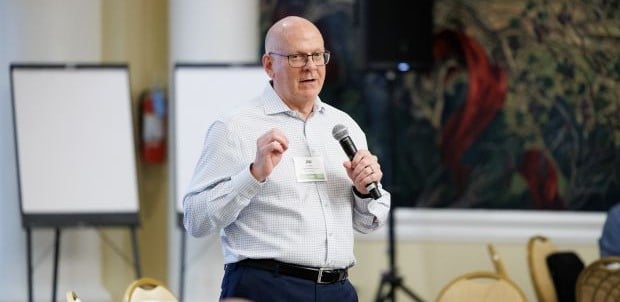 NeighborWorks Capital and the National Equity Fund that raised $110.4 million. The fund, the first of its kind and exclusive to the network, supports seven developments across the country, creating or preserving 517 units of affordable housing. NeighborWorks Capital and National Equity Fund expect this to be the first of many funds, and they expect the size of the funds to grow significantly over time.
While working on the initiative, he said, NeighborWorks Capital and National Equity Fund engaged 70 distinct investors in conversation about the network, raising the level of understanding of what the network does. “The more these investors understand,” he said, “the more interested they are.”
Peffley thinks of the fund as the first step in a broader capital strategy and the evolution of NeighborWorks Capital into more than a CDFI. The next step, he said, is to engage the network for input on the next capital-related initiatives that might be undertaken. He’s working with the National NeighborWorks Association and hosting listening sessions, like the one he hosted at the NeighborWorks Executive Symposium. There, leaders divided into groups on single-family housing, multifamily housing, CDFIs, and community development. But NeighborWorks Capital wants to make sure everyone has the chance to weigh in.
“LIHTC was a test case for us,” he said. “For the next step, we need a consensus from the network on what we would pursue. This is a long-term, ongoing project to create a growing advantage for NeighborWorks members.”
Together with network members, NeighborWorks Capital is engaging investors as NeighborWorks Capital Advantage Partners (NCAP), educating them on the opportunity to work with this national network of nonprofits and creating efficient pathways to move attractive capital into communities across the country.
The best time to have started on an initiative like this? Probably 10 years ago, Peffley said. “But the second-best time is now. Because 10 years from now, I’m confident that this is going to transform how these groups access capital – at least some types of capital.” He hopes the initiative will also help NeighborWorks raise grant capital.
“Time and again, I have heard NeighborWorks organizations yearning for ways to leverage our collective impact to scale financial-related opportunities,” said Sunshine Mathon, executive director of Piedmont Housing Alliance. “NeighborWorks Capital began charting that path with its NeighborWorks Capital Equity Fund. Speaking for myself, I am excited and optimistic that the next level of exploration will bear fruit too.”
Raising capital is a heavy lift – especially in these times, as funding sources shift. During Pelfrey’s session at the NES, participants like Melissa Noah of Wyoming Housing Network and Erika Mills of NeighborWorks Umpqua talked about the need not just to have a housing stack, but a housing mountain or a housing skyscraper.
“We know network members need capital at a scale that far exceeds what CDFI lending alone can provide: more than $30 billion is needed to move the projects in your pipelines from plan to reality,” he said. “Our focus is to help the network reach a broader set of capital sources—and to do so on preferred terms.”
The Network is uniquely positioned to lead in this moment, he said. “Collectively, Network members are among the nation’s largest producers of affordable housing. They innovate. They combine unmatched national reach with deep local relationships. They operate within a community of accountability and support that strengthens resilience in difficult markets. And they bring trusted, bipartisan credibility with members of Congress because their impact is visible in their districts.”
The network also represents one of the largest opportunities in the market for banks and investors seeking scale and impact in communities, whether they be urban, suburban, rural or Native. We have a tremendous opportunity, he said, “if we are willing to challenge assumptions, broaden our perspective and act with purpose.”
Learn more by connecting with NeighborWorks Capital.